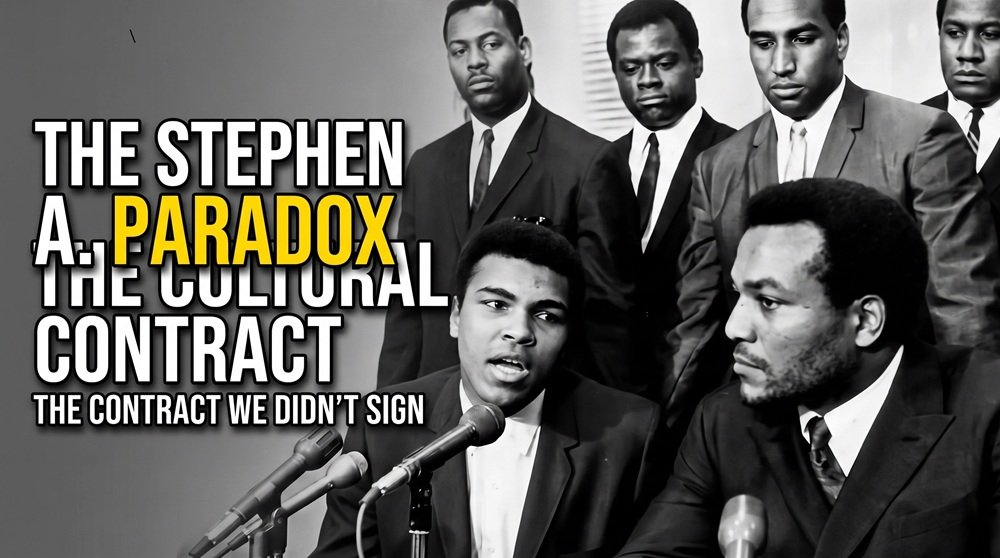
The Stephen A. Paradox – The Cultural Contract we never signed.
THE CONTRACT WE NEVER SIGNED
There is a cultural contract in Black America – one we never signed, but still enforce.
It’s invisible. It’s inherited. It’s emotional. It’s historical. It’s contradictory.
It shapes how we judge each other, how we interpret loyalty, how we interpret betrayal, how we interpret representation, and how we interpret growth.
This essay is the full version – deeper than the podcast, heavier than the episode, and containing everything we built behind the scenes.
This is the foundation of the Stephen A. Paradox.
THE ORIGIN OF THE CONTRACT – FORCED UNITY
Unity wasn’t a choice. It was survival.
Segregation forced Black America into one cultural space – one set of expectations, one shared struggle, one shared identity.
This unity created cultural soldiers:
- Muhammad Ali
- Harry Belafonte
- Bill Russell
- Nina Simone
- James Baldwin
- Lorraine Hansberry
- Sammy Davis Jr.
They weren’t just individuals. They were symbols.
And symbols come with rules:
- Don’t embarrass the culture.
- Don’t forget the culture.
- Don’t abandon the culture.
- Don’t evolve too far from the culture.
- Don’t represent yourself – represent us.
This is the cultural contract.
It wasn’t written. It wasn’t agreed upon. But it was enforced.
THE FULL AMUSEMENT PARK THEORY
The cultural contract is like an amusement park – but not everyone sees the same park.
Some people see the rides.
The joy. The progress. The wins. The breakthroughs.
Some people see the lines.
The waiting. The struggle. The exhaustion. The slow progress.
Some people see the broken rides.
The systems that never worked. The promises that never delivered. The opportunities that never came.
Some people see the people who never got in.
The ones locked out. The ones forgotten. The ones erased.
Some people see the people who built the park but never enjoyed it.
The ancestors. The labor. The sacrifice.
Some people see the people who were told they didn’t belong in the park.
The exclusion. The rejection. The humiliation.
Some people see the people who got kicked out of the park.
The incarceration. The criminalization. The systemic removal.
Some people see the people who were allowed in… but only if they behaved.
The performers. The entertainers. The “acceptable” ones.
Your experience in the park shapes your expectations – and your expectations shape your judgment.
This is why two people can look at the same situation and see two different truths.
This is why the cultural contract feels different depending on where you stood in the park.
SAMMY DAVIS JR. – THE FIRST CROSSFIRE
Sammy Davis Jr. lived in two spotlights:
- The cultural spotlight
- The mainstream spotlight
He was the first to experience the paradox:
“Represent us… but don’t evolve past us.”
When he aligned with the culture → he was celebrated. When he aligned with mainstream acceptance → he was questioned.
He was punished for being too accepted. He was punished for being too successful. He was punished for being too visible.
This tension still exists today.
THE FIRST CONTRADICTION – GROWTH VS LOYALTY
Growth requires leaving certain rooms. But leaving certain rooms creates tension.
Because the cultural contract says:
“Grow… but don’t grow past us.”
This is the first contradiction.
It’s the contradiction Stephen A. Smith lives in. It’s the contradiction every public figure lives in. It’s the contradiction every successful Black person feels.
The culture wants you to win – but only in a way that feels familiar.
WHITE NORMS VS MODERN NORMS )
This section wasn’t fully explored in Episode I, but it belongs here because it shapes the contract.
White Norms (Cultural Interpretation)
This is NOT about white people – it’s about how the culture interprets certain behaviors:
- emotional calm
- structured communication
- therapy language
- boundary‑driven relationships
- conflict avoidance
- individualism over collectivism
These behaviors are often interpreted as:
“safe,” “professional,” “non‑threatening,” “acceptable.”
Modern Norms (Cultural Interpretation)
This is NOT about Black people – it’s about how the culture interprets survival‑shaped behaviors:
- emotional intensity
- expressive communication
- cultural loyalty
- community‑driven expectations
- survival‑shaped relationship norms
These behaviors are often interpreted as:
“real,” “authentic,” “connected,” “culturally aligned.”
The contradiction:
White norms are accepted when Black women adopt them… but questioned when Black men adopt them.
This contradiction begins in Episode I – and explodes in Episode II and III.
THE RELATIONSHIP CONTRADICTION
This contradiction is cultural symbolism – not stereotypes.
Black woman + white man → cultural empowerment
“You go girl.” “Love is love.” “Choose peace.” “Do what makes you happy.”
Black man + non‑Black woman → cultural scrutiny
“You sold out.” “You abandoned the culture.” “You couldn’t handle a strong Black woman.” “You don’t like Black women.”
Same choice. Different reaction. Different symbolism.
This contradiction is rooted in Episode I’s cultural contract:
Fear of losing representation. Fear of losing loyalty. Fear of losing identity.
This is why the contract matters. This is why the paradox exists.
PULL QUOTES – EPISODE I
- “Unity wasn’t a choice – it was survival.”
- “The cultural contract is inherited, not chosen.”
- “Growth shouldn’t feel like betrayal.”
- “Your experience in the park shapes your expectations.”
QUESTIONS – EPISODE I
- Which part of the cultural contract do you still feel today?
- Do you think unity still exists, or did it evolve?
- Which cultural soldier shaped your understanding of representation?
- Does growth feel like betrayal in your community?
- How do you interpret the Amusement Park Theory in your own life?
📊 POLLS — EPISODE I
- Does the cultural contract still exist?
- Yes
- No
- It evolved
- Which part of the contract hits hardest?
- Representation
- Loyalty
- Growth
- Betrayal
“In Relation To”
TUSKEGEE PAJAMA POINTS – “IT WAS NEVER ABOUT PAJAMAS”
The Tuskegee Pajama Points explain why a simple debate – “Should students wear pajamas to class?” – reveals a much deeper cultural tension.
It’s not about clothes. It’s about symbolism. It’s about discipline. It’s about generational norms. It’s about survival vs access. It’s about how culture interprets behavior.
.
- THE TUSKEGEE RULE – PRESENTATION AS PREPARATION
Historically, Tuskegee and other HBCUs enforced strict dress codes.
Not because they cared about fashion – but because they cared about presentation.
To them:
- Dress = discipline
- Discipline = preparation
- Preparation = elevation
The rule wasn’t “no pajamas.” The rule was:
“If you’re preparing for excellence, present yourself like excellence.”
This is the first Pajama Point: Dress is cultural signaling.
- RESPECTABILITY VS MODERN AUTHENTICITY
The pajama debate exposes a philosophical divide.
Respectability Norms (Historical)
- Dress well
- Speak well
- Represent the culture
- Show seriousness
- Show discipline
Modern Norms (Current)
- Comfort
- Authenticity
- Individual expression
- “I’m here to learn, not perform.”
- “Clothes don’t define intelligence.”
This is Pajama Point #2: Two generations see the same behavior differently.
- SURVIVAL NORMS VS ACCESS NORMS
Older generations grew up in a world where:
- education was a battlefield
- respect had to be earned
- presentation protected you
- discipline was survival
Younger generations grew up in a world where:
- education is expected
- access is normal
- comfort is allowed
- authenticity is valued
This is Pajama Point #3: Survival norms vs access norms.
- THE SYMBOLISM OF THE CLASSROOM
The classroom symbolizes different things depending on the era.
Older generations:
A place you fight to enter.
Younger generations:
A place you feel entitled to occupy.
So pajamas feel:
- disrespectful to one group
- irrelevant to the other
This is Pajama Point #4: The same space carries different emotional weight depending on the era.
- THE CULTURAL FEAR BEHIND THE DEBATE
The fear isn’t about pajamas – it’s about slippage.
Older generations fear:
- loss of discipline
- loss of seriousness
- loss of cultural excellence
- loss of competitive edge
Younger generations fear:
- being policed
- being judged
- being restricted
- being forced into outdated norms
This is Pajama Point #5: Both sides fear losing something important – just not the same thing.
- HOW IT CONNECTS TO THE STEPHEN A. PARADOX
The pajama debate is a micro-version of the cultural contract.
- Older norms vs modern norms
- Discipline vs authenticity
- Representation vs individuality
- Symbolism vs practicality
Stephen A. represents the “old norms.” Younger audiences represent “modern norms.”
His critiques feel like policing. Their behavior feels like disrespect.
This is Pajama Point #6: The pajama debate mirrors the cultural paradox.
- WHY THIS MATTERS FOR THE PANEL
The Tuskegee Pajama Points are PERFECT for the Deeper Dive panel because:
- It’s a harmless topic with deep cultural roots
- It exposes generational tension
- It shows how norms evolve
- It reveals how culture interprets behavior
- It ties directly into Episodes I–III
- It gives panelists a concrete example to debate
This is Pajama Point #7: Small behaviors reveal big cultural truths.
PULL QUOTES
- “It was never about pajamas – it was about symbolism.”
- “Survival norms and access norms create different expectations.”
- “The classroom means different things depending on the era.”
- “The pajama debate is a micro-version of the cultural contract.”
QUESTIONS
- Do dress codes still matter in 2026?
- Is comfort a sign of confidence or a sign of decline?
- Does presentation still shape opportunity?
- Are modern norms replacing respectability norms?
- Which side of the pajama debate do you relate to?
POLL OPTIONS
- Should students wear pajamas to class?
- Yes
- No
- Depends on context
- Which norm shapes your view?
- Respectability
- Modern authenticity
- Both



Post a comment: